

About This File
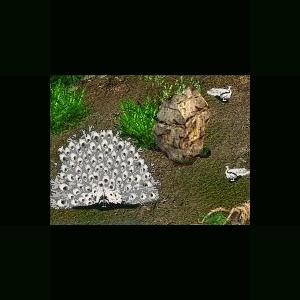
White Indian Peafowl by Genkicoll
The Indian Peafowl is also known as the Blue Peafowl or Blue Peacock. Peacock refers to the male of the species, whereas peahen refers to the female.
There are three species of peafowl in the world, the Malaysian Peafowl, of southeast Asia and Maylay Peninsula, the Congo Peafowl of the African Rainforests and the Indian Peafowl. The white peafowl are not albino, just a color variation of the Indian Peafowl. These birds have blue eyes. White peachicks start out yellow with white wings.
Wild Indian Peafowl are primarily found in the Rainforests of India, Bangladesh, and Sri Lanka. Due to its adaptability, they have been domesticated for over 2000 years, and have spread around the world with the help of human civilization. Escaped domestic peafowl have established wild populations on every continent except Antarctica.
The primary habitat of the Blue Peafowl includes water, rock and thick rainforest. They live in large groups and are very social animals, and are rarely bothered by human presence. They are just as at home in a city park as they are in the dense forest. Guests to your zoo will be thrilled to see this beautiful bird proudly displaying its plumage!
Many thanks to Jens for allowing us to recolor Willie T's original Indian Peafowl! Fully compatible with the Indian Peafowl in the ZTU Catalog section of our database
Updated July 23, 2026 by Jay to prevent the animal from disappearing sometimes when rotating a zoo, to have all views of each animation use the same animation speed, to show the appropriate animation of the female when it lies down and stands up, to make the sound file smaller without changing how it sounds, to adjust the spacing and punctuation in the animal info, to add an image of the young for the animal list window, to allow the animal to appear in the purchase menu for the MM Kid's Map and zoos based on that, to have the preferred object tooltip match the preferred object image, to have young sometimes move slower than the adults, to give ZT more time to check if a tranquilizer dart hit an escaped animal, and to remove duplicate images, unnecessary files, and configuration lines.
Updated 2010-11-21
Just to save space with less in zip and smaller image.
Nothing new.
Recommended Comments
There are no comments to display.
Please sign in to comment
You will be able to leave a comment after signing in
Sign In Now